© Shaun Gladwell
La Gaya Scienza
2026
9 bis rue Dalpozzo 06000 Nice
-
Vernissage le 14 novembre, de 18h00 à 20h00
-
15 novembre au 19 décembre
Mercredi au Samedi 14h00 - 18h00
Curators : Annie Aguettaz et Barbara Polla
An artist of the body and of movement, an artist of the sovereign gesture—to quote Carolyn Christov-Bakargiev—and an artist of somatic memory according to Simon Ree, Shaun Gladwell represented Australia with the Australian Pavilion at the Venice Biennale in 2009. For many years, Annie Aguettaz has showcased and championed Gladwell’s work, which seamlessly bridges performance and video art—a vision at the very core of her newly created structure, Moving Art.
At La Gaya Scienza in Nice, Annie Aguettaz presents a “mini”-retrospective: an invitation to journey through the videographic oeuvre of Shaun Gladwell, featuring no fewer than six video works and video installations.
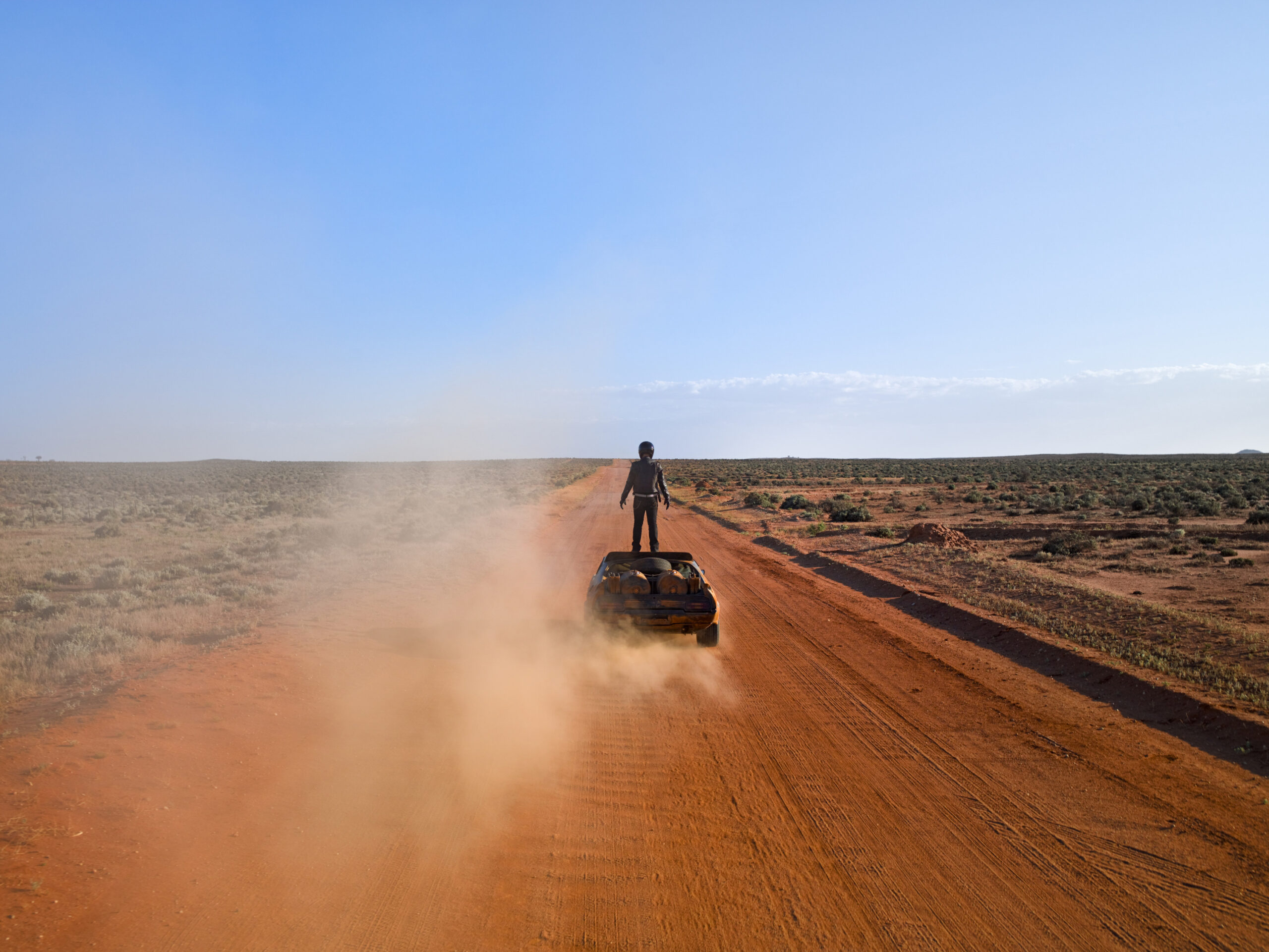
2-channel video, HD, 15’13 and 12’28, colour, sound, 2011.
The title and visual design directly reference the iconic Ford Falcon XB GT Interceptor driven by Mel Gibson in the dystopian Mad Max film franchise. Shot in the Australian Outback, the video takes place in the very landscape that fueled this cinematic mythology of speed and post-apocalyptic desolate beauty. Perched atop the roof of the vehicle as it hurtles down a red-dirt track, the artist balances upright, transposing the fluid gestures of skateboarding and surfing—the art of carving space, the perpetual negotiation of equilibrium—onto a moving automobile. Captured in a continuous tracking shot at a constant elevation, the linear perspective of the straight road stretching into the horizon evokes a profound sense of infinity and suspended time. By placing a vulnerable human body atop a powerful machine amid the arid red earth, Gladwell once again reinterprets the complex dialogue between man, technology, and the overwhelming expanse of the wilderness. Despite the actual velocity of the vehicle and the peril involved, the signature use of slow motion softens the bravado of a hyper-masculine stunt, reshaping it into a poetic, almost contemplative, and restorative ritual. Moving far beyond sensationalist athleticism, the performance seeks to inhabit movement itself.
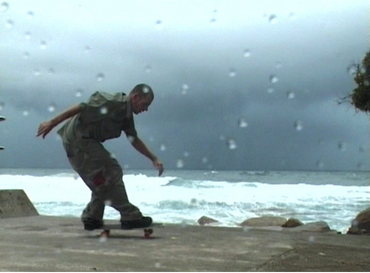
Video Pal DV, 8’35, colour, 2000
The video features the artist himself performing freestyle skateboarding maneuvers atop a concrete promenade overlooking the sea at Bondi Beach in Sydney. In the background, a churning ocean and a sky heavy with gathering storms lend the scene a dramatic, melancholic atmosphere. Recorded in real time and subsequently slowed to an extreme degree, the piece transfigures the act of skateboarding—typically bound to raw energy, speed, and urban subculture—into a hypnotic, almost contemplative choreography. The work offers a modern reinterpretation of the Romantic sublime, evoking the paintings of Caspar David Friedrich: a solitary silhouette confronting the overwhelming power of the elements. Meanwhile, Kazumichi Grime’s experimental soundscape heightens the visual tension between the fluid grace of the moving body and the impending storm.
Kazumichi Grime : “I used the sound of a shorting microphone cable to create static like sounds and the rest was processed samples and synthesis. It fitted the mood of the video. This was the first sound design collaboration I did with him and many more have been undertaken since 2000, supporting his incredible rise as one of the major figures in video art internationally.”
Gladwell’s Storm Sequence has gone on to become one of the most famous pieces of modern video art from Australia.
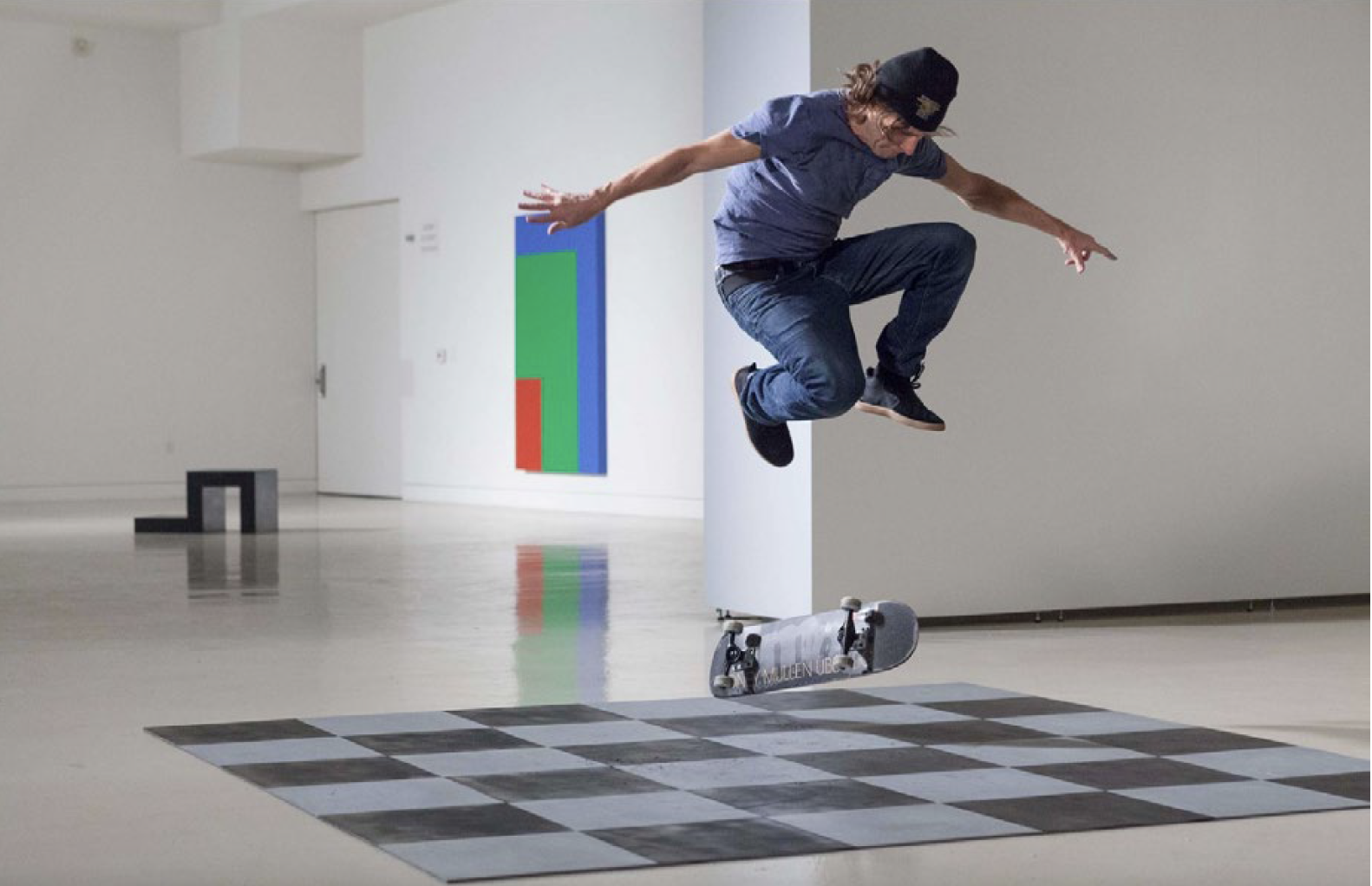
HD video, 53’29, colour, sound, 2016
The work brings the subculture of skateboarding into direct confrontation with institutional art history, most notably the Minimalist movement of the 1960s. Professional skateboarders—among them freestyle skateboarding legend Rodney Mullen, alongside Jesus Esteban and Hilary Thompson—navigate the confines of the Torrance Art Museum – Los Angeles. They interact directly with Minimalist art structures that recall or replicate the stark, geometric forms of major figures such as Donald Judd, Carl Andre, Tony Smith et Ellsworth Kelly.
Minimalist sculpture, traditionally sacrosanct, passive, and destined for distant contemplation within a white cube, is here reimagined as a physical obstacle, an element of urban architecture, and a dynamic canvas for expression. Shaun Gladwell posits that no rigid boundary separates geometric Minimalist sculpture from street furniture—be it benches, concrete ledges, or handrails. In the artist’s eyes, the skateboarder is a reader of architectural form.
Much like Storm Sequence, the video employs hypnotic slow motion and a refined aesthetic to transform skate tricks into a profoundly meditative dance centered on gravity, balance, and temporal control. The organic fluidity of the human body in motion stands in stark, striking contrast to the rigidity, coldness, and formal simplicity of the Minimalist structures.
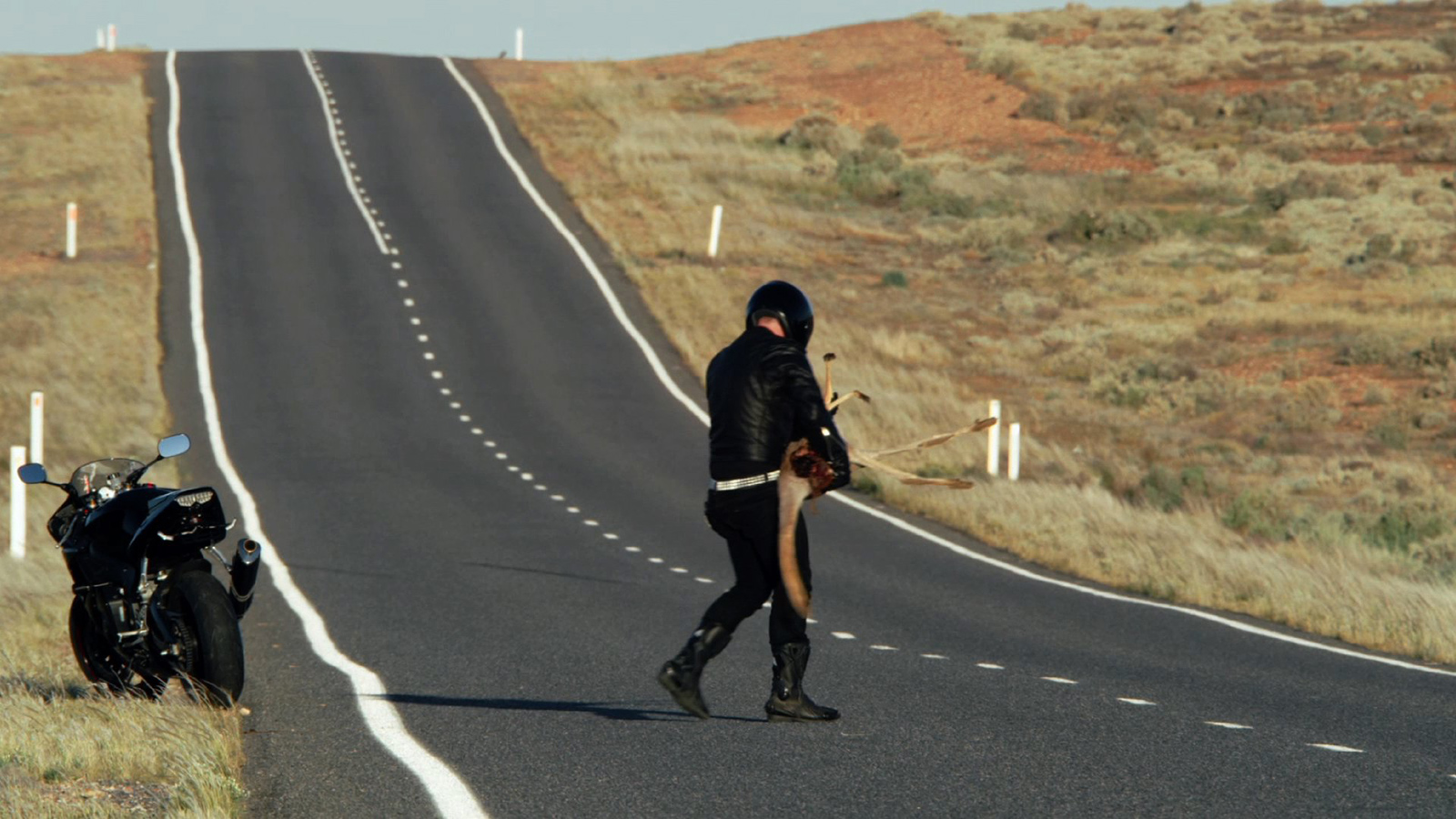
HD video, 9 minutes, colour, sound, 2016
Apologies belongs to a major series by Shaun Gladwell—Apologies 1–6—which explores the vulnerability of the human body, regret, and the rituals of reconciliation and empathy through a choreography of gesture. Across each video channel, the artist performs a physical act of apology, bowing, or prostration while bound to or associated with a machine. Here, Gladwell revisits one of his signature motifs: motorcycle culture, complete with full-face helmets and protective riding gear. What resembles a rigid suit of armor stands in stark contrast to the sincerity and vulnerability of the gesture. The extreme use of slow motion stretches time, transfiguring a commonplace posture of humility into a hypnotic, ritualistic dance. By concealing the face behind a helmet, Gladwell depersonalizes the act of apologizing. The apology no longer emanates from a specific individual; instead, it becomes a universal reflection on the human condition and the fragility of social bonds. The contrast between heavy motorcycle gear and a posture of physical surrender generates a poignant poetic tension between external power and inner vulnerability. As in Interceptor, the machine serves as more than a technological object—it merges with the performer, becoming an active participant in the choreography.
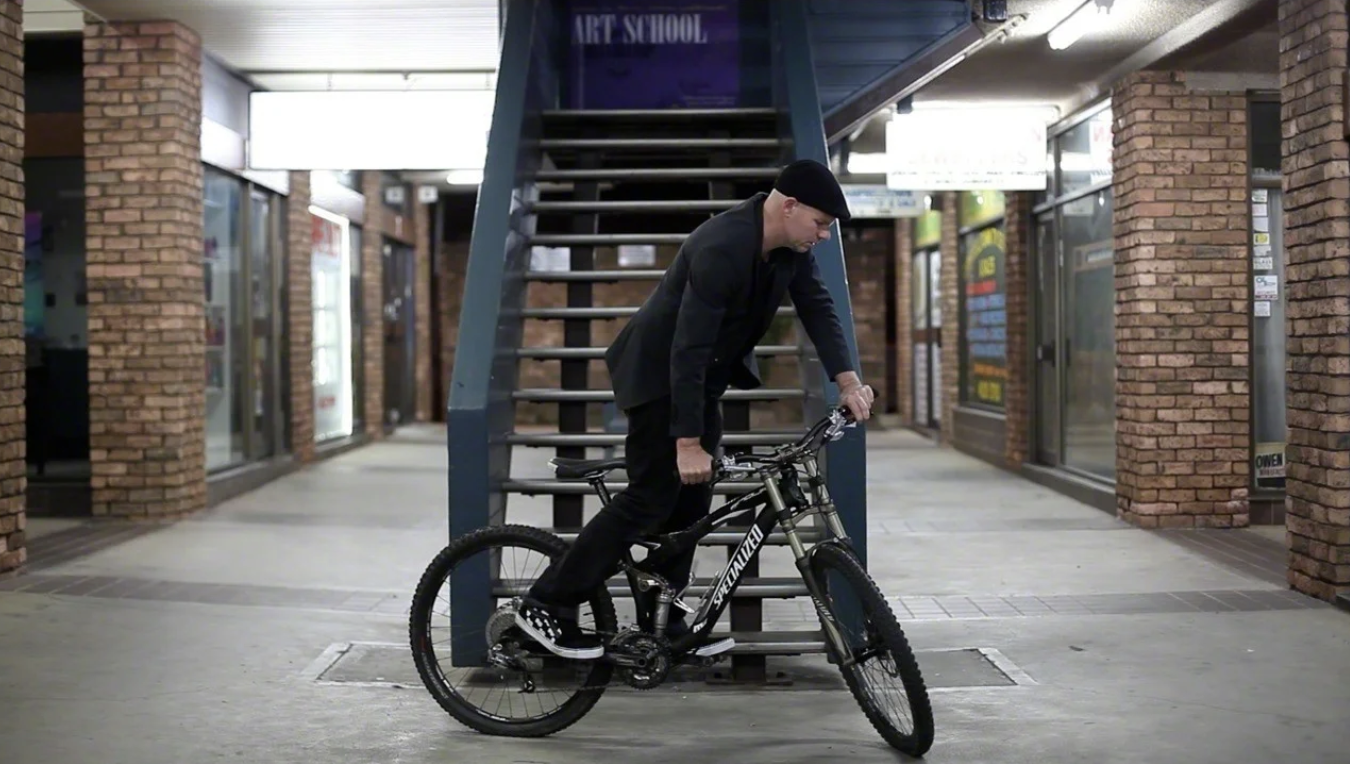
HD video, 11 minutes, colour, sound, 2014
Shaun Gladwell utilizes the cycling technique of the trackstand—the art of remaining stationary—which consists of keeping a bicycle perfectly motionless balanced on two wheels without placing a foot on the ground, achieved solely through micrometric adjustments of body weight and pedal tension. The artist sustains this prolonged posture of equilibrium across a wide array of urban environments, from street corners and subway stations to public squares and gallery spaces. While the bicycle is traditionally an instrument of transit and speed, Gladwell transforms it into a vessel for meditation, temporal suspension, and absolute stillness. Captured with his signature approach to slow motion, the video stretches this moment of intense concentration, transfiguring a continuous physical exertion into a living sculpture.
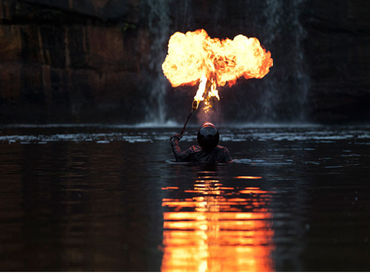
HD video opera, 2 hours 18 minutes, colour, sound, 2013
Der Fliegende Holländer (The Flying Dutchman) is a monumental video fresco conceived by Shaun Gladwell. Originally commissioned by the Rotterdam Philharmonic Orchestra under the baton of Yannick Nézet-Séguin, the work was designed as an immersive backdrop and visual counterpoint to Richard Wagner’s eponymous opera.
Gladwell shifts the traditional Wagnerian maritime universe into the contemporary world of surfing; the Dutchman’s eternal wandering finds its echo in the surfer’s perpetual quest when confronting the waves and the ocean. The video operates a bold montage between the rugged coastlines of Norway—where Wagner’s own ship was diverted in 1839—and the wild breakers of Australia’s Tasman Sea. Here, the forces of nature become a metaphor for the characters’ desire, sacrifice, and ultimate destiny, with the performers translating the dramatic narrative through a direct physical confrontation with the sheer power of the water.
Throughout the performance, the main characters (the Dutchman, Senta, Erik, and Daland) handle video cameras themselves. The camera thus serves a dual purpose: as a tool of scientific analysis « debunking » the spectral apparition of the ghost ship, and as an intimate diary capturing raw emotional states. In the opera’s coda, Gladwell employs his signature visual technique of inverting the image. The world is literally turned upside-down, representing redemption, weightlessness, and the spiritual transcendence of the lovers as they finally unite. Accompanying the character of Erik is a « spirit guide » (portrayed by Indigenous artist Daniel Boyd), grounding the narrative within the ancient memory of the Australian continent.