OVNi X Festival Videoformes Clermont-Ferrand
As part of the Videoformes festival, taking place from Thursday, March 13, to March 16, to mark the festival’s 40th edition and the 10th anniversary of Bienheureuses Rencontres, Ovni has been invited to present a video program on Thursday, March 13, at 2 p.m. Natalie AMAE has selected three videos: “Sous le Ciel” by Jeremy Griffaud, “Mer intérieure” by Guilia Grossman, and “Hyperphantasia” by Justine Emard.
This program will be followed by a panel discussion featuring Nathalie AMAE—artistic director of the Ovni Festival—Elise ASPORD, and Santiago TORRES.
Nathalie AMAE is also a member of the jury for the international video competition, whose winners will be announced on Sunday, March 16, at 7 p.m.
Three works by three artists emblematic of the OVNi Festival’s editorial direction, developed by the OVNi Biennale, whose next edition is scheduled for fall 2026.
We are committed to tracing the historical trajectory of video art over the past 60 years and presenting this art form for what it is: an avant-garde art form, as it has the potential for constant evolution in step with technological innovations.
Furthermore, we champion emerging artists, artists from the South region, and hybrid practices: the artist Jérémy Griffaud is the perfect embodiment of this; he is now an international figure and has been supported by the Festival—and specifically by Odile Redolfi—since his early days. He blends the art of watercolor with that of pixels, the physical and material dimension intertwined within the syntax of video games.
We find this historical trajectory in Justine Emard’s work not only because she is interested in our relationship with the need to represent, through images, our experience of the world (both within and outside our individual selves), but also because she has embraced AI to use it as a tool for extending both the structure of thought and the evolution of humanity.
The selection of Giulia Grossmann allows us to highlight several key areas: the breadth of our programming, since we previously presented one of her documentaries as part of an exhibition; our commitment to positioning OVNi within a broader production initiative, extending beyond our writing and filmmaking residencies; and finally, OVNi is expanding its visual literacy education program; in addition to our Art & Science Encounters, we place great importance on the quality of innovative outreach. In particular, we have launched a project with an expert in disability and culture—a ministerial advisor—focused on conveying visual content to a blind audience, whose methodology is applicable to all types of audiences.
FOCUS SCREENING :::
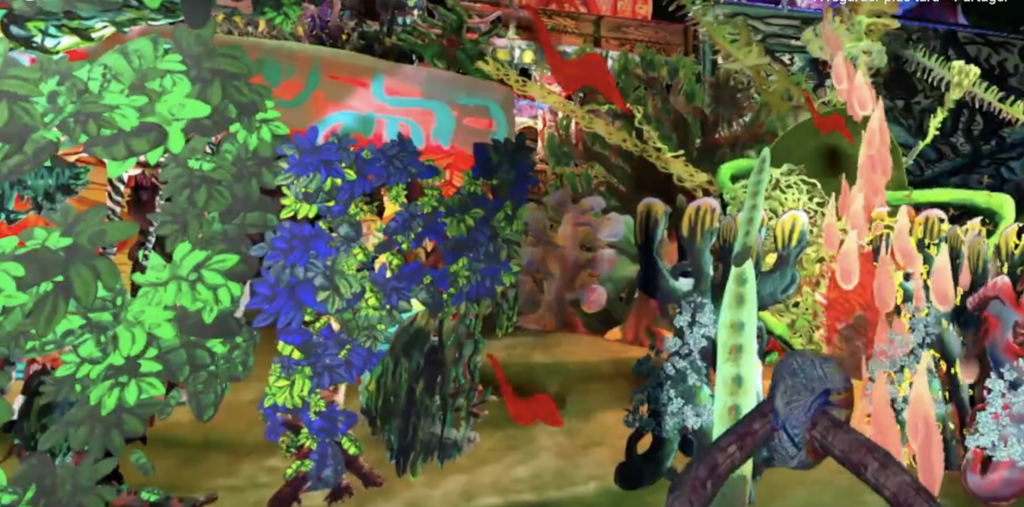
Jérémy Griffaud | Sous le ciel | 2024 | 10’ | color
Inspired by the series of paintings from the Message Biblique, a masterpiece of universal and spiritual significance and the centerpiece of the museum’s permanent collection, Jérémy Griffaud has created a panoramic projection covering the entire surface of the walls. Four of Chagall’s paintings particularly caught his attention, exploring the themes of the original Paradise and its loss (Le Paradis, Adam et Eve chassés du Paradis), of the dream (Le Songe de Jacob) and hospitality (Abraham et les trois anges).
Designed as a loop, the visual animation draws the viewer into the heart of a teeming, dreamlike world where transitions occur between an Edenic garden and island cities, between the underworld and the celestial expanse. In this movement toward an inner world or an elsewhere, a multitude of hybrid beings swarm, their gestures and movements themselves repetitive. An eternal return to the self that, like Chagall’s works, encompasses the different times of the world—past, present, and future—whether lived or imagined.
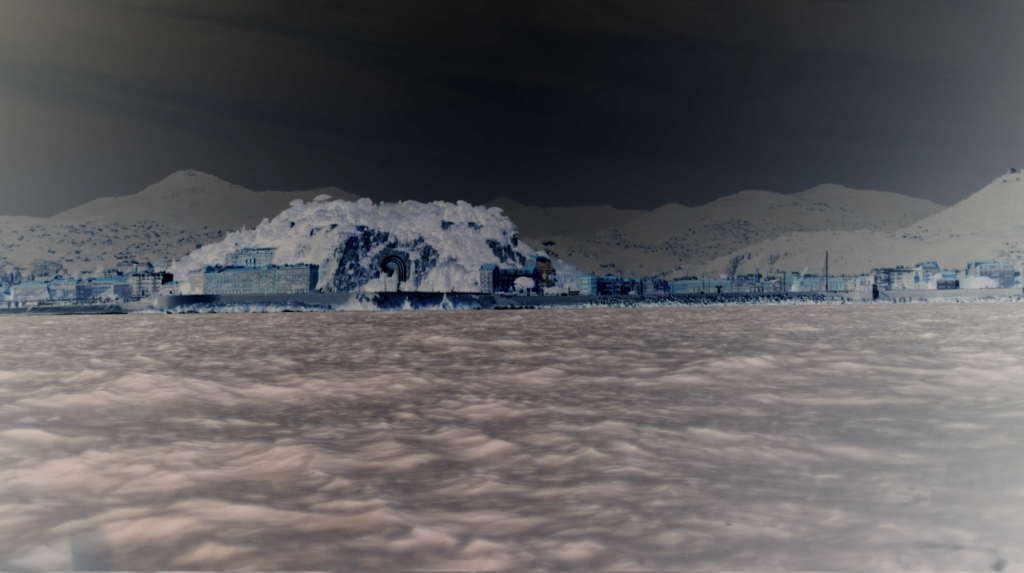
Julia Grossman | Mer intérieure | 2024 | 10’13 | color, sound
I had the opportunity to meet Jamila and Robert through an invitation from the OVNi Festival and a proposal to create an experimental film related to the Cultural Olympiad. Our shared interest centered on water sports, partly because I’m working on a project about the sea, and partly because Nice is a city that faces the Mediterranean. Spontaneously, the Nice sailing club, which we had contacted, put us in touch with a couple passionate about sailing despite their visual impairments. So I boarded their sailboat with the initial goal of highlighting their achievements at sea, despite Jamila’s total blindness and Robert’s partial blindness.
However, what really caught my attention was the discussion I had with them about their ability to perceive complex nuances, which is influenced by their physical sensations and mood, as well as by the emotions they experience as a result of being on board.
This conversation inspired me to explore the possibility of visually capturing this ability to express emotions through altered images and sound design that reflects the emotional state of their experience at sea.
Despite her blindness, Jamila is able to perceive changes in the weather visually through black-and-white contrasts. This extraordinary ability, caused by a neurological process known as the “Riddoch phenomenon,” was first described by the Scottish neurologist George Riddoch in 1917. He described how certain patients could perceive colours and movements in their blind visual field, even in the absence of perception.
This film is therefore an attempt to convey, through images and sound, the emotional experience of boarding Jamila and Robert’s sailboat.
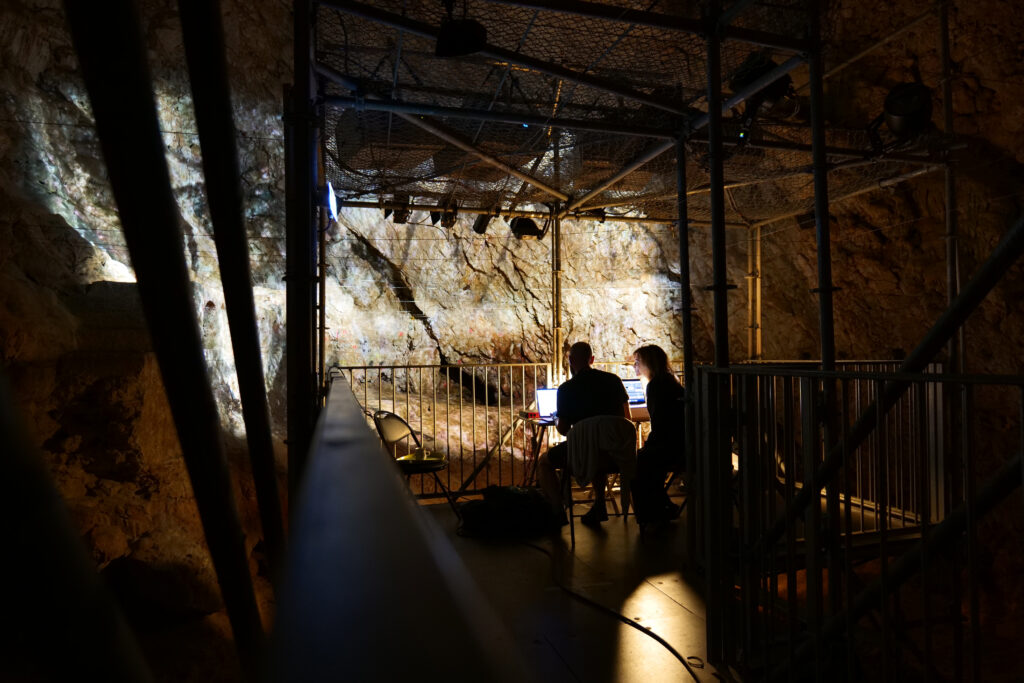
Justine Emard | Hyperphantasia, from the origins of images | 2023 | 12’ | color, sound
From the depths of the cave to the depths of our brains, Hyperphantasia creates a space where 36,000 years of imaging technologies converge, in search of the origin of images. In the Paleolithic era, people ventured into the depths and darkness of caves, driven by the human desire to inscribe a work of the mind upon the cave walls.
In 2022, computational science enables us to analyze large amounts of data and generate predictions.
Using a scientific database from the Chauvet Pont-d’Arc Cave, an artificial neural network was trained to generate new images of prehistory for the creation of the artwork. A video wall slowly comes to life, offering a glimpse of a “new” prehistory, parallel imaginations of our ancestors. In 2021, a mission by CNES and ESA is studying the evolution of sleep in space. Electroencephalographic data recorded over several nights allowed the artist to work with signals from dreams in space.
These signals from the depths of our unconscious are embodied in 3D-printed dreamscapes. A landscape born of mental images emerges in the light of the video. From the generation of entirely new images of prehistory using a machine-learning model to the extrusion of dream sculptures from space, we witness the birth of new images from the depths of our imaginations, which will merge and synchronize.